A practical companion to the hermetic tradition
The 7 Hermetic Laws
Seven principles that have been quoted for a century and understood by almost nobody — set out in plain language, with one practice for each, and a chart you can keep on the wall.
One-time payment · Instant digital access · 60-day money-back guarantee
Quoted everywhere, explained nowhere
“As above, so below.” You have seen it on a poster, in a caption, tattooed on someone's forearm. It comes from a specific philosophical tradition, it means something quite precise, and the version circulating online is usually a fortune-cookie of the original.
The seven principles were set out in 1908 in a slim book called The Kybalion, itself drawing on a much older hermetic current running back through the Renaissance to Alexandria. The source text is short, deliberately oblique, and written in the English of its period. Most people who buy it never finish it.
This is the companion that should have come with it. Each law explained in modern language, with what it does and does not claim, where it came from, and one concrete practice for the week you spend with it.
The seven laws
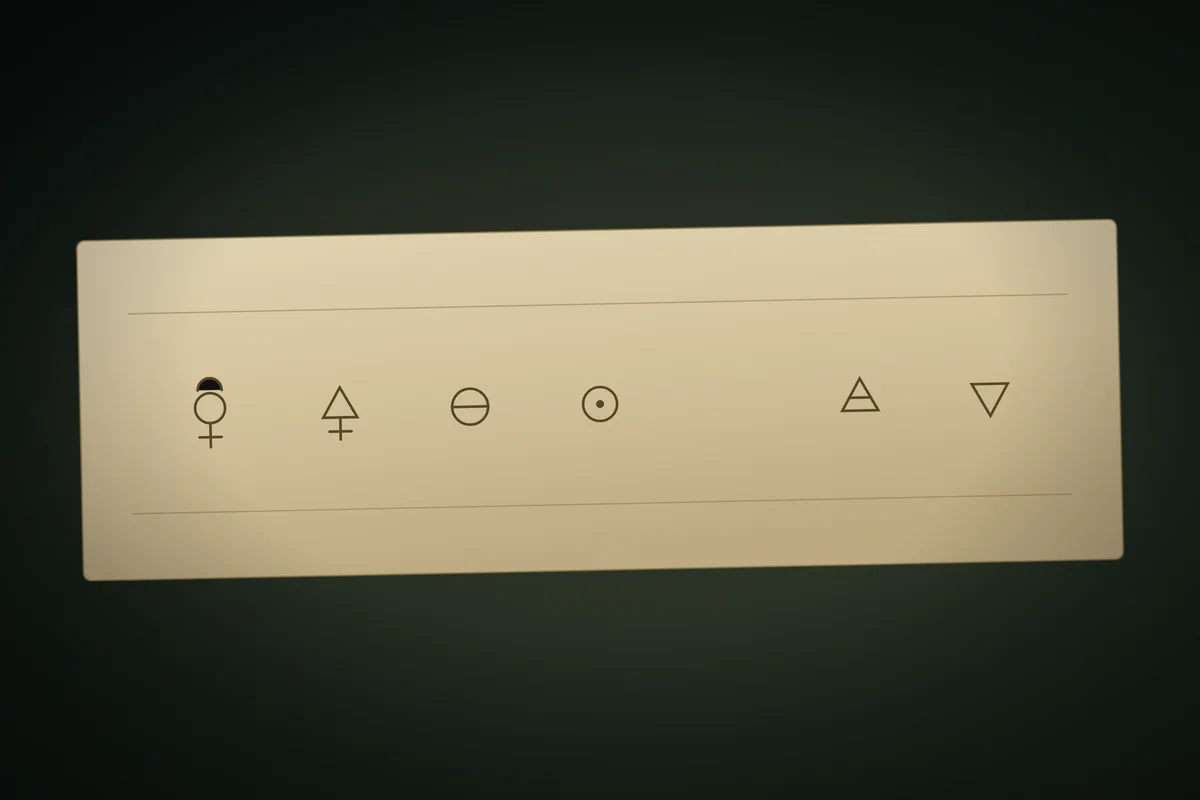
One chapter each. One week each, if you follow the practice. The middle column is how the tradition states it; the right-hand column is what the guide argues it actually claims.
| Law | As the tradition states it | What it actually claims |
|---|---|---|
| Mentalism | “The All is mind; the universe is mental.” | That mind is the ground of the enquiry — not that thinking about a thing produces it. The chapter spends its length on that distinction, because everything downstream depends on it. |
| Correspondence | “As above, so below; as below, so above.” | A method: look for the same pattern at a different scale, then test whether it holds. It was an instrument of enquiry long before it was a slogan on a poster. |
| Vibration | “Nothing rests; everything moves.” | That stillness is an appearance, not a state. Kept carefully separate from the modern misuse of the word “frequency”, which the chapter takes apart. |
| Polarity | “Everything is dual; opposites are identical in nature.” | That opposites are two ends of one scale, not two different things. The most immediately usable of the seven in an ordinary week, and the practice reflects that. |
| Rhythm | “Everything flows, out and in; all things rise and fall.” | That the swing is the normal condition, not a failure. What the tradition offers is a stance towards the swing, not a way of stopping it. |
| Cause & effect | “Every cause has its effect; there is no such thing as chance.” | The one most often flattened into superstition. The chapter separates the defensible reading from the fatalism that gets attached to it. |
| Gender | “Gender is in everything; all things have their masculine and feminine principles.” | Not what a modern reader assumes on first contact. Explained in its own terms, with the historical context, without euphemism and without embarrassment. |
A page from the guide
So you know what the writing is like before you pay for it. From chapter four, on Polarity.
“Heat and cold are not two things. They are one thing, read at two points on a single scale, and the moment you can say where on that scale you are standing, you can also say which direction to move. The tradition asks you to do this with qualities that feel far less measurable — courage and fear, generosity and grasping — and insists they behave the same way.
This is not a consolation. It is a practical instruction, and it has an uncomfortable edge: if fear and courage are one scale, then you are never waiting for courage to arrive. You are already on the scale, and the only question is which way you intend to walk.”
The 7 Hermetic Laws · Chapter four · Polarity
Seven chapters in that register, plus the practice attached to each one.
What the companion includes
Four pieces, sent together the moment you order, yours permanently.
-
I
The 7 Hermetic Laws — the main guide
One chapter per law: the original formulation, what it means in modern language, where it came from, and the common misreading. 118 pages, PDF.
-
II
The Seven Laws at a Glance — printable chart
All seven on a single page: name, formulation, the one-line reading, and the practice. Designed to be printed and pinned up.
-
III
Seven weekly practices
One concrete exercise per law — a week each, seven weeks in total, or dip in wherever you like. Each takes a few minutes a day and asks you to observe something specific.
-
IV
The glossary
The vocabulary of the tradition — hermetic, alchemical, correspondence, mentalism — defined without mystification, so you can read the primary sources for yourself afterwards.
A look at the chart
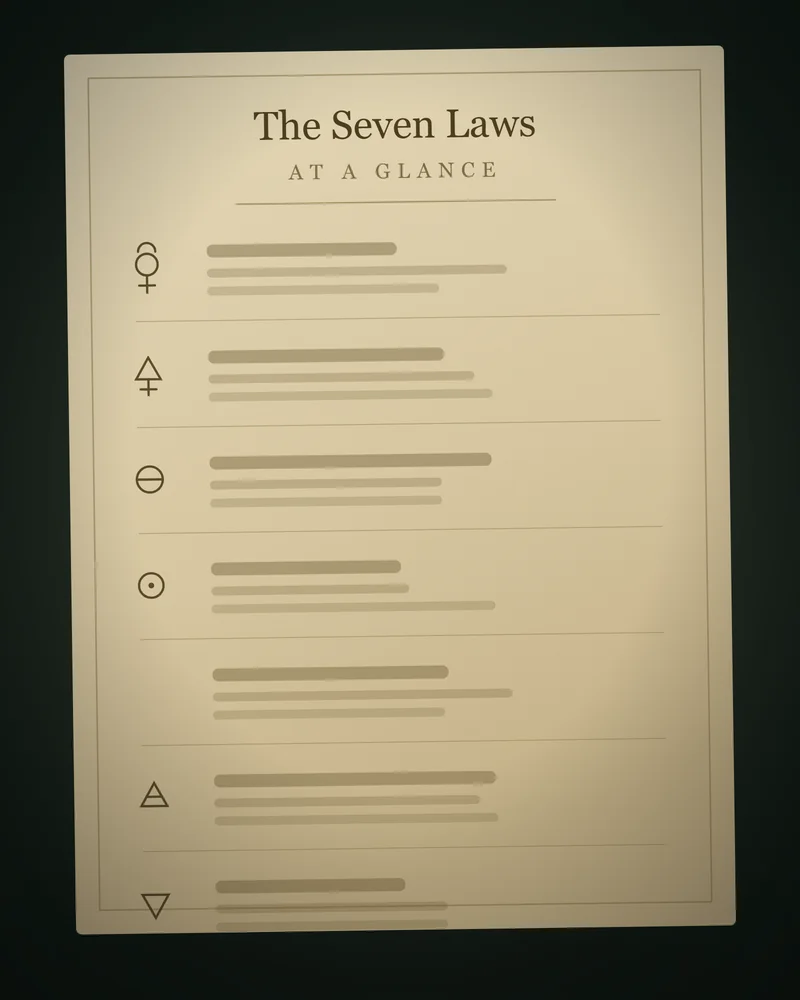
The chart is the piece people end up using long after they have finished reading. Seven rows, four columns: the name, the formulation as the tradition states it, the plain reading, and the practice.
It exists because the laws are easy to nod along to and hard to hold in mind at once. Seeing all seven together is what turns them from seven quotations into a single structure — which is how they were meant to be read.
Included as a print-ready PDF in both A4 and US Letter.
Who should read this
This is for you if
- You have run into these principles repeatedly and want to understand them properly.
- You tried the original text and put it down.
- You want the philosophy with its history attached, not stripped of it.
- You would rather practise one law for a week than read about all seven in an evening.
This is not for you if
- You are looking for the law of attraction. That is a different, much later idea, and this guide is explicit about the difference.
- You want a method for producing specific outcomes, money or events. Nothing here promises that, and no honest guide could.
- You want an academic translation of a primary source. This is a modern practical companion, and it says so.
- You need support with a health or mental-health concern. A book of philosophy is the wrong tool for that, and a qualified practitioner is the right one.
Start with the first law
The guide, the chart, the seven practices and the glossary arrive in your inbox within a few minutes. The first chapter is about twenty minutes of reading, and the practice attached to it starts tomorrow morning.

Read the whole thing first, then decide. The guarantee runs 60 days, which is longer than it takes to work through all seven chapters twice. Finish it, disagree with it, and still ask for your money back — one email, no justification required. Terms on the Refund Policy page.
The 7 Hermetic Laws
Complete companion · 4 items
One-time payment · No subscription
Add it to my orderOne click — your payment details are already on file. Nothing else to fill in.
Honest answers
Is this The Kybalion?
No. This is a modern, practical companion to the seven principles as popularised by The Kybalion (1908) and drawn from the wider hermetic tradition. It is not a reproduction, translation or reprint of that text. Where we quote a formulation we say so and attribute it.
Is this the law of attraction?
No — and the guide is deliberately clear about it. The law of attraction is a twentieth-century idea that borrowed some hermetic vocabulary. The principle of mentalism is not a promise that thinking about something produces it, and this companion explains exactly where that misreading came from.
Do I need to have read anything beforehand?
No prior reading of any kind is assumed. The glossary is there precisely so you can start from zero — and finish able to read the primary sources yourself.
How long does it take to work through?
The guide can be read in a weekend. Followed as intended — one law per week with its practice — it fills seven weeks. Both ways are fine; the guide is laid out for either.
What actually shows up, and when?
An email, within minutes, holding four downloads: the 118-page guide, the print-ready chart in A4 and US Letter, the seven practices and the glossary. Nothing physical is sent. Missing after an hour means a spam or promotions folder — write to soporteyumi@gmail.com and we will resend it by hand.
Is there anything recurring attached to this?
No. Twenty-seven dollars, paid once. No membership, no renewal, nothing that can bill you later.
What happens if I disagree with the book?
You get your money back, and we would rather you did that than kept something you found unconvincing. Sixty days, no explanation owed. Ask at soporteyumi@gmail.com or through Digistore24, which returns it to whatever you paid with, usually inside 5–10 business days. Terms: Refund Policy.
Seven principles, finally legible
Not a secret, not a shortcut — a structure that people have been thinking with for a very long time, handed over in language you can actually use.
One-time payment · Instant digital access · 60-day money-back guarantee